Wednesday, February 24, 2016

The Meeting of the Mountains


When the bus pulled into Senmonorom, I thought I might be in heaven. Mondulkiri ("Mountain of the Mandala") Province in North-Eastern Cambodia is aptly named. Despite being the largest province in Cambodia, it is the most sparsely populated. Senmonorom, the capital city, has a population of under 7,000 and no post office or bank. Perched on a sloping hillside, and surrounded by mountains and jungle, this one road town was a perfect escape from our mad journey thus far. 


Mondulkiri province

We enquired about bunking up at a local elephant rescue program, but the one-eyed expat at Bunong Place gave us the unfortunate news that our first choice of location was booked solid for the weekend. Instead, we trudged the two miles down a red clay road to the Nature Lodge, and snagged their last bungalow. Although we really wanted to stay at The Elephant Project, I'm glad we found the Nature Lodge. It consists of an open-air dining room, a treehouse hammock lounge, and a dozen isolate bungalows spread out on a hillside overlooking rolling green hills. Cows and horses roam freely around the property, acting as weed whackers and lawn mowers. The staff are a group of local teenagers learning English, hospitality, and business management. Our bungalow had two large beds surrounded by mosquito nets, a hot shower (luxury!), and a hammock on the front porch. 


Our little cabin on the hillside

We walked back to town for dinner at Savankini. It felt good to be back in a rural area; I enjoyed recognizing and getting to know other travelers and shop owners around town. After dinner, we rented a motorbike from The Green House and drove to see a hilltop pagoda. This was my first ride on a scooter since a big crash in 2010, and I was definitely nervous. But unfortunately, motorbikes are the only reasonable form of transportation in many areas in South East Asia. I think I may have broken one of Pete's ribs by squeezing so hard and permanently damaged his hearing with my yells - "Slow down!" "Watch out for that bike!!!" "Ahhh!" He handled it all admirably and did a great job driving up and down the steep hills and bumpy dirt roads. 


They see me rollin

We climbed to the top of a nearby hill and looked out at the beautiful mountains in all directions. It felt so good to be outside! We couldn't stop smiling as we headed back to the lodge for beers and card games all evening. After a breakfast of muesli, fruit, and yogurt, we rented the motorbike again for a day of exploring around town. We stumbled on an Pnong indigenous rally for government control of land pricing. Like many developing nations rich in natural resources, land value in Mondulkiri has skyrocketed lately, and indigenous tribes have been losing their farmland and income. Everyone was dressed up for the occasion, and had plenty of foods and crafts for sale. 


They were pretty excited to pose for a picture

We left the rally and headed for a coffee plantation on the outskirts of town. Besides acres and acres of coffee trees, the farm grew durian, passionfruit, and rambutan. We sat by a peaceful lake and drank delicious (and really strong) coffee. 


Coffee!


Passionfruits

Senmonorom is also known for their waterfalls, so we spent a few hours in the afternoon hiking around looking for a cool place to dip our toes. We passed many indigenous women and children walking along the dirt paths herding livestock or carrying vegetables. We ran into a group of Chinese girls also visiting the waterfall; they insisted upon taking a picture with me!


Muddy roaring rivers


Kiddos at work

Later in the day we visited a Buddhist monastery surrounded by more colorful, ornate pagodas. To me, Buddhist monks seem like such an exotic group, so full of zen or nirvana or enlightenment or whatever that they are above the mundane activities of us average folks. It was amusing to see young monks engaged in daily life: doing laundry, chatting with their families, or skipping between buildings (don't they levitate?). 


Pagodas


Robes in the wash


At the end of the day, we climbed "Sunset Hill." With an amazing view of the whole valley, it was the perfect place to watch the sun drop below the horizon and paint the sky orange, purple, and pink. 


Sunset hill


Unbeatable Senmonorom sunset

For me, Sunday was a highlight of the entire trip. We headed out early to a Putang village about ten miles into the hills from Senmonorom. As soon as we pulled into town, my mouth dropped open. Half a dozen elephants came into view. They plodded between the houses, their heads level with the second story rooms, or stood in the shade of nearby trees. We met our Putang guide and marveled at the huge animals looming over us. 


Mr. Hung and Ramtuk

Without further ado, Mr. Hung told Ramtuk to kneel down and motioned for me to hop onto his head! When Ramtuk lumbered back to his feet, my stomach swooped and I had a moment of vertigo. There isn't much to hold onto up there, and each step feels like a small earthquake. Ramtuk's leathery ears flapped against my legs as we trudged down the red dirt road towards bright green hillside and dense jungle. At first I was feeling pretty cool; the few others in our group were nervous and visibly uncomfortable riding their elephants, but my years riding horses gave me an advantage. It was just like riding a big, slow Clydesdale! I felt balanced holding on with my thighs and was glad I didn't have to cling to Ramtuk's neck. But it wasn't long before this feeling of confidence evaporated. Ramtuk knew he could take advantage of me (I didn't even speak his langauge!), so he ducked into the underbrush to gobble down bamboo stalks at any opportunity, nearly decapitating me with low-hanging branches on several occasions. 


Trying to convince Ramtuk to stay with the group!

I lay flat on Ramtuk's back as we lumbered through the forest like a massive bulldozer, and tried not to get dropped off on a tree. Finally we made it to the river (it took us even longer because Ramtuk took the most circuitous path to avoid stepping in any mud or other elephant poop). Here we swam, bathed the elephants in a roaring waterfall, and learned more about the culture we were experiencing.


Crossing the first river

Mr. Hung, the Putang mahout ("elephant keeper"), uses Ramtuk essentially as a tractor to carry loads of crops and wood into the village. At night, Ramtuk is hobbled and can roam around, looking for the never-ending supply of bamboo. Beung, our Khmer guide from Senmonoram, did most of the translating between us and Mr. Hung. He also told us that a tiger roams the hillside, prompting mahouts to keep their elephants hobbled close to the village.At the end of the day we journeyed back up through the forest, across the rolling green hillsides, and down the red dirt road into the village. 


Oxen grazing in the Putang village


We finished the trip sitting in Mr. Hung's home and meeting his wife and children. The house consisted of one large room, a dirt floor, a thatched roof, no electricity, and no doors. Mrs. Hung was cooking rice over an open fire in the middle of the floor when we arrived. She alternated between shelling beans and chasing out the squawking chickens and pigs that kept sneaking in for a snack. Beung told us a little more about the many hill tribe minorities (including the Putang) who each have their own language and village. It is a close-knit, small community that lacks access to, and even knowledge of, modern amenities. There is little to no education, few medicines, no birth control, and all travel is done on foot or by elephant. Some of the older folks have never even been down to Senmonoram (which is only 10 miles away). 


Mrs. Hung

Suddenly a moto sped up outside the house. Apparently I left my passport at the place where we rented mopeds the day before. Word got around that I might have come up to the village for the day, and the whole town was in an uproar to return my passport! I couldn't decide whether to be grateful for their help and hospitality, or given the feeling they wanted to make absolutely sure I would be leaving their country. Either way,  I loved the countryside and small villages. I didn't want to leave a place where I felt I had made friends and could wave while walking through town. Everyone was so happy, helpful, and friendly. 


Did I mention that elephant bodies are covered in sparse, prickly hairs? 
My thighs were covered in tiny scratches by the end of the day.

We had dinner our last night in the Khmer Kitchen. I tried a delicious Cambodian stew. Six Human Rights Watch workers ate at the table next to us; apparently the Human Rights Watch organization is very active in helping villagers fight for their land against large companies starting plantations. One of the kitchen employees offered us a ride back to the Nature Lodge in his truck at the end of the night. As we drove out of town, a pick-up truck with blacked out windows and a tarp over the bed sped past us heading east. Our driver said they were illegal loggers heading to the Vietnam border with wood. Before he dropped us at the lodge, we asked him why he moved up here to the mountains from Phnom Penh. He simply said he hated big, crowded cities and love the fresh air. We heartily agreed.   

On Monday morning we hopped in an enormous bus heading towards the Vietnam border just a few miles south. The bus quickly overheated on the steep mountain roads and we spent the next hour and a half baking in the sun while brave men lowered themselves into the roadside gutters and scooped up water to replace the missing coolant. After a while, the bus was deemed a loss, and the driver called a friend with a minibus. 


One last look at the mountains

So Monday afternoon found us flying through the Cambodian countryside, squished in the back of a 12-passenger van with 15 Khmers, two babies, and a one-armed Italian, heading at a breakneck pace for Vietnam...


Thursday, October 2, 2014

Getting the Khmer Culture

On the other side, we shared a taxi with a Spanish couple for the two hour ride to Siem Reap. It probably would have been longer, but our driver casually double passed cars in oncoming traffic. Siem Reap is an odd town - an entire community developed to entertain visitors who have come to see Angkor Wat. There are cheap souvenirs, cheap (semi-authentic) Khmer restaurants, and cheap tuk-tuk tours of the ruins. 
We went all out on Cambodian-style BBQ when we arrived. We ordered shark, ostrich, and snake and grilled them on a small metal bowl over an open flame right at our table. Dinner was followed by an Apsara traditional dance show across the street. A troupe of local teenagers dressed in wild costumes danced several traditional Khmer stories and fairytales, accompanied by a drumming group.
The next morning we woke at the truly terrifying hour of 4:30am for sunrise at Angkor Wat. The temples were beautiful and impressive, but I was put off by the crowds of tourists and swarms of hawkers at every turn. We had a wonderful time exploring ruins overrun by vegetation and looking closely at the intricate reliefs adorning every wall. My curiousity was piqued particularly by the interesting mix of Hindu and Buddhist sculptures. 


Hindu reliefs


Main temple of Angkor


Did I mention the temples are huge?


Bridge decor


More reliefs


Nature takes over


Not just sharing the temples with other tourists!

Our poor tuk-tuk driver said he had been up partying all night and had yet to sleep, so he napped in a hammock while we had a brunch of coconut water, muesli, yogurt, and fresh mango and pineapple. By noon we were exhausted and had seen our fill, so we napped at the hostel before catching a 4:45pm bus to Phnom Penh. 
It always seems to me that the journey is just as fun as the destination, and this bus ride surely did not disappoint. We were entertained by gorgeous green countryside and loud, raucous Khmer sitcoms from the television at the front of the bus. Despite the lack of English subtitles, we knew when to smile because half the bus exploded with laughter every few minutes. After the sitcoms ended, the driver switched over to incredibly cheesy Korean music videos. Every single one seemed to be about heartbreak, gang violence, or heartbreak caused by gang violence.
We arrived, bruised and slightly carsick, at a deserted bus station in the outskirts of Phnom Penh around midnight. A single tuk-tuk driver offered to take us to a random guest house near the Mekong riverfront, where we fell into bed immediately. 
We had our favorite meal of the trip the next morning at Phnom Penh's central market. Markets like these take a little adaptation, especially on an empty stomach. The smells are overwhelming: too many people crammed in tiny aisles and shops, raw meat hanging from the ceiling above every stall, hundreds of live chickens stuffed into minuscule crates, spices and sauces thrown on sizzling grills in all directions, and no organized waste disposal. But the food is divine. We plopped down on plastic stools in front of a friendly-looking lady. She nodded and filled a bowl with cold noodles, soup, and veggies. I pointed out spring rolls and sticky rice with peanuts wrapped in banana leaves. A man at the adjoining stall brought us tea (on the house) and iced coffees. It was perfect. Once sitting, we were able to fully enjoy the ordered chaos of the market. 


Psar Thmay


Num banh choc (rice noodle soup) and num anksom sach chrouk (sticky rice cake)


Fresh seafood from the Mekong

Next, we flagged down a tuk-tuk and headed for the Vietnamese Embassy. We needed to pay for entry visas in advance. After leaving cash and our passports (yikes), we wandered the neighborhood looking for a way to exchange the rest of our Cambodia Riel for Dong or US dollars. No luck. But we did find a wonderfully secluded resort that allowed visitors to use the pool with the purchase of one drink. I decided I could swing a $1 soursop smoothie, and spent the next hour lounging with my feet in the cool water. 
After picking up our passports with their fresh Vietnam visas, we took a tuk-tuk to the Killing Fields for the most sobering and sickening experience of the trip. To say I was uneducated about the recent Cambodian genocide is a gross understatement. Two million people were tortured, killed, and dumped in mass graves during the four year rule of Saloth Sar (Pol Pot) and his band of deranged subordinates. And the rest of the world was largely unaware. 
I felt distinctly uncomfortable walking between the deep impressions in the ground and looking at the collections of bones and clothes displayed around the fields. It wasn't necessarily distasteful; I think the community should be able to mourn and remember in any fashion they choose, but I felt disrespectfully close. Imagine visiting Ground Zero and viewing suit jackets smeared with dust and blood, pieces of bone, and maybe the contents of someone filing cabinet. It's too personal, too raw. 


Buddhist Stupa containing skulls of Pol Pot's victims


Left: Spirit house (shrine to appease the spirits)
Right: Bones of unidentified victims at Choeung Ek

Pete and I slowly pulled ourselves out of a despondent silence as we headed back towards the city. We decided on a quiet night near the Mekong and enjoyed a few Anchors, a Cambodian pizza (cooked in the common Khmer fashion - with plenty of marijuana), and a bowl of flavorful amok curry. Our quiet night turned crazy when we were surrounded by a handful of young hawkers. They giggled as they showed us hand games and tried to sell us colorful bracelets and postcards. I caved and bought two bracelets from one boy who looked about ten. Unfortunately his younger brother was incredibly competitive and followed us all the way back to the hostel, trying to get us to buy more bracelets from him. 

From a rooftop in downtown Phnom Penh


Crossing the Mekong


Flooded fields on the outskirts of Phnom Penh

The next morning, our senses and emotions completely frazzled, we took a comfortable minibus away from the overwhelming city and into the refreshing peace of the eastern highlands...

Saturday, September 27, 2014

Busy, busy Bangkok

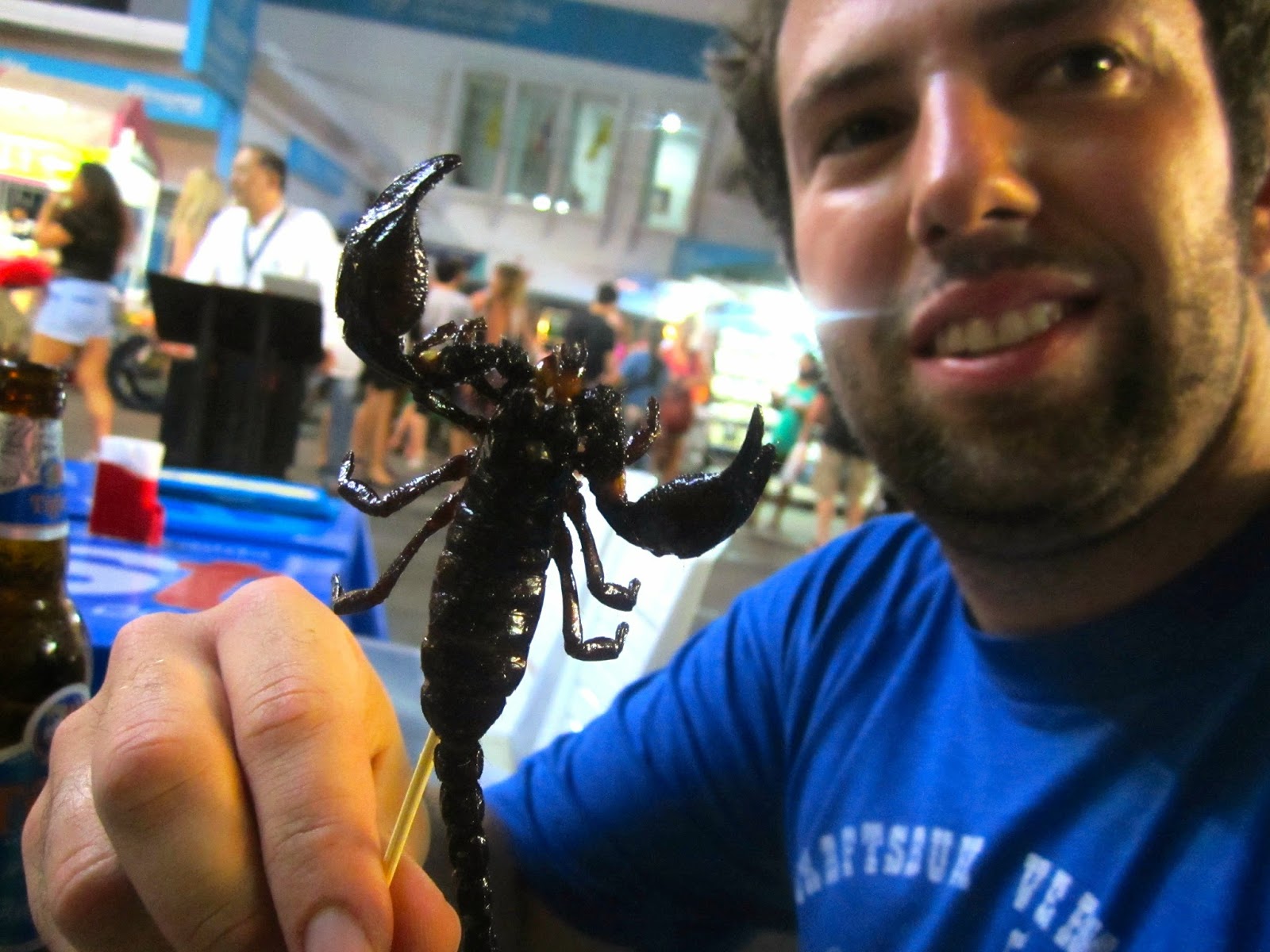
Pete arrived in Singapore at 1am on Monday morning. We slept for a few hours and turned right back around to fly to Bangkok for an obligatory tour down Kho San Road. After trying various street food (scorpion, pad thai, and spring rolls) and shopping for souvenirs, we got horribly lost on the way to the hostel in the middle of the night and ended up in a large, complex monastery. Pete was bit by a dog and we definitely scared some young monks who were out playing with remote control cars, but we eventually managed to find our way around the monastery and back to our room. 


Pete loooooves grilled scorpion

The next morning we woke up bright and early (5am) to catch the train to the Cambodian border. Riding the third class train from Bangkok to Aranya Prathet, taking a tuk-tuk to the border, crossing into Poipet, and hiring a taxi to Siem Reap is a common backpacker journey. We were both excited to start this epic adventure, despite it being pitch black at that hour. We hopped out of the taxi and headed to the train station ticket window. I reached for my purse to pay for our tickets and oh crap - my wallet was gone. I immediately knew what happened: I took it out to pay for the taxi ride, and since I knew I was going to get change, I didn't put it back in my purse right away. Instead, I left the wallet sitting on my lap, where it must had slid off around a turn. In the darkness I didn't notice it was gone. The taxi driver gave the change to Pete, who stuffed it in his pocket, so I never needed my wallet to put the change away. We spent several frantic minutes rushing throughout the taxi queue, poking our heads in each vehicle, looking for our driver. But I knew it was too late. He was long gone to who knows where. Now we were stranded at the train station with no money and no time. If we somehow went looking for the driver, we would surely miss the train. If we didn't, there was no hope for my wallet. I had lost cash (about 1000 baht), my credit card, my debit card, my NUS student ID, and my health insurance card. Oddly, I was most distraught about the lost of my Singaporean Student ID. It was the one truly irreplaceable item, and a prized souvenir from the summer.
But in the spirit of adventure, I decided there was no use wasting our day on some wild goose chase for a man we may not even recognize if we saw him. Thankfully there was an ATM in the train station. Pete got out cash, we bought our train tickets, I called my sister to have her cancel my cards, and we boarded the last car. It was a ramshackle old thing with wooden walls and broken benches. Luckily most of the windows were also broken, so they stayed open and let in a wonderful breeze. 


Getting ready to board the train

When the train finally rumbled slowly out of the station, the sun was just peeking over the horizon. We chugged through the outskirts of Bangkok, past flimsy houses built inches from the tracks and toxic looking rivers clogged with garbage and debris. The train windows gave snapshots into the lives of those who live along the tracks: shirtless men grilling satay, women loading down motos with palm fronds and bamboo stalks, and children running amok through the crowded neighborhoods. 


Cruising through Bangkok

Finally the shacks and noisy roads gave way to immensely green rice paddies and farmhouses and palm forests. The train picked up speed (yikes) and clanged along the endless track. I spent a good portion of the seven hour journey exploring the train cars and leaning out the windows. Stepping from car to car was creepy and exhilarating. I felt like an outlaw from the wild west. The hinges were not enclosed; nothing was stopping you from climbing onto the roof or jumping out of the train at any point. I stood on the lowest step between two cars and leaned my whole body out of the train, letting the tall grasses brush against my legs as we sped east. 


Looking out of the train


Rice farmers at work

We reached Aranya Prathet just after 1pm and took a tuk-tuk to the popular border crossing. Immigration was a breeze with a US$20 Cambodian visa and a few extra bucks for the border guards. We walked through a gauntlet of hawkers and potential pickpockets pushing up against us and following us down the sidewalk, and finally stepped into the bright sun and red dirt roads of Cambodia.


Approaching the Kingdom of Cambodia


To be continued...